Recycled Polyester: What It Is, What It Saves, Where It Falls Short
Sep 25, 2026 · Dana Reyes
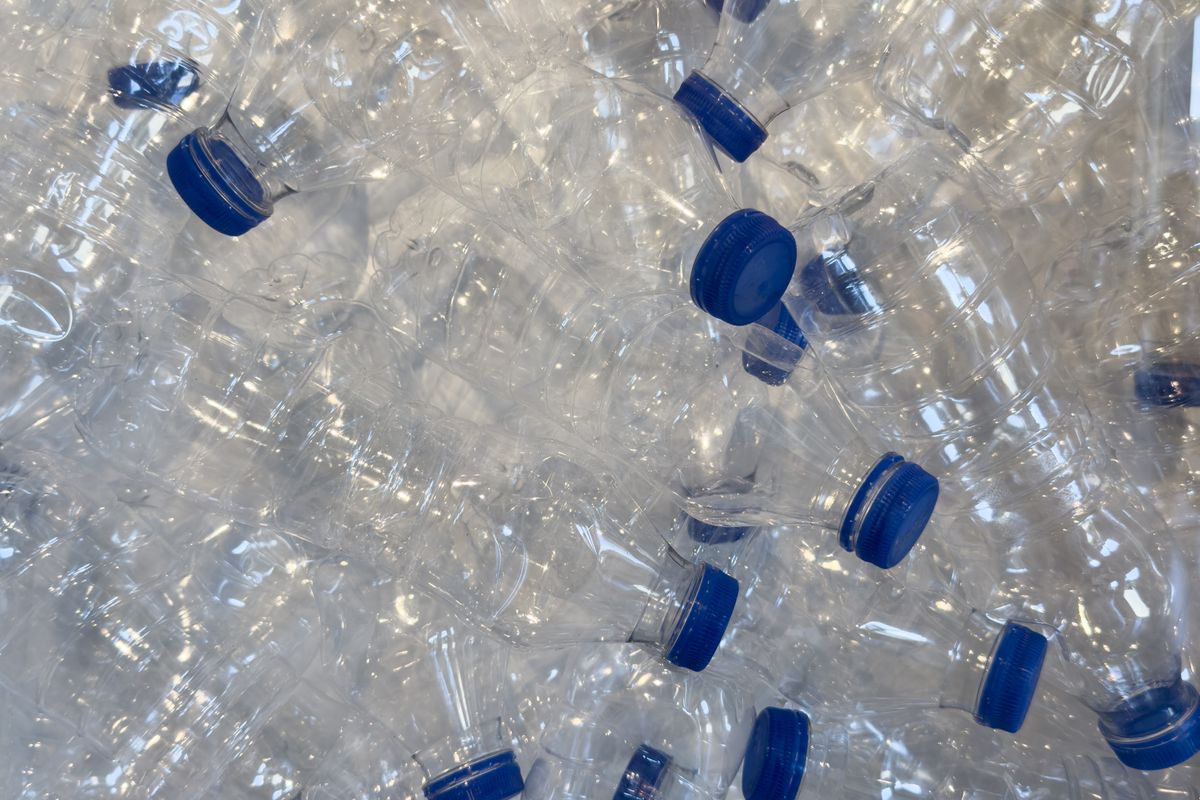
Recycled polyester is the most common sustainability claim in mainstream clothing, and the easiest one to misjudge, because the phrase carries an assumption nobody examines: that “recycled polyester” means old clothes became new clothes. Almost always it means plastic drink bottles became fabric — a real diversion of waste, and a route that ends where it started, with plastic that cannot be recycled again.
Where recycled polyester comes from
Recycled polyester is polyethylene terephthalate, the same polymer as virgin polyester, recovered rather than newly polymerised from fossil feedstock. Two routes exist, and they are wildly unequal in scale.
The dominant one uses post-consumer PET bottles: collected, sorted, washed, shredded into flake, melted, extruded into filament or staple, then spun and knitted or woven. Bottle streams are large and uniform, so this produces consistent feedstock at industrial volume, which is why bottles-to-fabric became the industry default.
The second takes discarded polyester textiles back into fibre, mechanically or through chemical depolymerisation. This is the version most people imagine, and it is the version that barely exists. Figures cited in the research behind Changing Markets’ Spinning Greenwash report put bottle-derived material at around 98% of recycled polyester. Chemical routes handle blends and contamination better than mechanical ones, but they remain costly, energy-intensive and small next to global synthetic fibre production.
So buying a garment described as recycled polyester almost never means you participated in garment-to-garment circularity. You bought plastic that used to be a bottle.
What it actually saves
There is a genuine benefit, often stated in a form that makes the honest version harder to accept. Polyester’s heaviest environmental cost sits at the front of its life: extracting fossil feedstock and polymerising it. Using PET that already exists skips that step, so recycled polyester generally takes less energy and emits less carbon to produce than virgin does. The direction holds across the literature.
The magnitude does not. The figure cited most often in brand marketing, roughly 59% less energy, traces to a single 2017 study for the Swiss Federal Office for the Environment. Other comparisons land higher or lower, and the spread comes from things unrelated to the fibre: where the system boundary is drawn, and above all the electricity grid running the plant. A facility on coal-heavy power posts a far worse result than one on clean power. Read any hangtag percentage as marketing rather than measurement.
Those comparisons also tend to cover cradle-to-gate. Washing, drying and disposal sit outside them, which is precisely where polyester’s most persistent problems appear.
Where the story runs out
Recycling does not remove plastic. A recycled fleece is not biodegradable, persists in the environment identically, and melts at the same low temperature. What the recycled feedstock changes is upstream; what you wear and wash is chemically the same material.
Microfibre shedding may be worse. A laboratory study commissioned by Changing Markets and run by the Microplastic Research Group at Cukurova University in Turkey tested 51 garments from Adidas, H&M, Nike, Shein and Zara. Fabrics made mostly of recycled polyester shed an average of 12,430 fibres per gram of sample, against 8,028 for mostly virgin samples — about 55% more. Recycled fibres were also shorter, averaging 0.42 mm against 0.52 mm. Shorter fibres travel further and are more readily taken up by organisms, so a smaller particle is not a smaller concern.
Two caveats. It is one study, its brand comparison was not perfectly balanced because suitable virgin samples were unavailable for every label, and variation between brands dwarfed the gap between recycled and virgin — which suggests construction, finish and yarn type matter enormously too. Take it as evidence that recycling does not solve microplastic pollution, not as an argument for virgin polyester.
The bottle-diversion problem sits alongside. PET bottles recycle well into themselves; one can become another several times over. Turning one into a shirt removes it from that loop permanently, and if demand for recycled PET exceeds supply, packaging makers fill the gap with virgin PET made from petroleum. Whether any given garment is a net improvement depends on something the hangtag will never say: what those bottles would otherwise have become. The scale question is plain enough from industry data cited by Changing Markets: recycled polyester’s share of the polyester market slipped from 12.5% to 12% in a recent year because virgin grew faster.
Finally, mechanical recycling shortens polymer chains, so each pass yields slightly weaker fibre. That is why recycled polyester is often blended with virgin to hit performance specifications, and why bottle-to-fabric is better described as open-loop downcycling than as circularity.
Reading a recycled claim
The common problem is not a lie. It is a sentence carrying no information.
“Made with recycled materials” tells you nothing actionable. It could describe a garment that is 90% post-consumer fibre or one with a recycled thread in the waistband. Under the FTC’s Green Guides, an unqualified recycled content claim is read as meaning the whole product apart from minor components is recycled; where only part is, the claim should be clearly and prominently qualified by percentage by weight. A bare Möbius loop raises the same issue, since unexplained it suggests the item is both recyclable and entirely recycled. Look for a number; the absence of one is itself informative.
Next, look for a named standard. The Global Recycled Standard and Recycled Claim Standard, both run by Textile Exchange, provide audited chain of custody; GRS additionally carries environmental and social requirements, while RCS covers content verification alone. Either means someone other than the seller checked the paperwork. The word “recycled” on its own rests entirely on the seller.
Then consider the type. Post-consumer content — waste that had already reached a consumer — is the stronger claim; pre-consumer manufacturing scrap requires evidence the material would genuinely have entered the waste stream. Nothing on a label tells you whether the input was a bottle or a textile, so assume bottles unless a brand states otherwise.
Labelling accuracy is not a hypothetical worry. Changing Markets documented items sold online as recycled polyester that later appeared on the same site described simply as polyester, with no announcement. A claim that quietly disappears usually was never solid. Blends deserve the same scepticism our guide to composition tags applies generally: a polyester-cotton garment makes recycling harder on both components.
What this means at the rack
Recycled polyester is better than virgin at the specific thing it was designed to address: reducing extraction and polymerisation of new fossil carbon. It is not measurably better at durability, not better at microplastic pollution, and does not make the garment recyclable at end of life. Everything else about the purchase still has to be judged on its own terms.
The useful response has less to do with the fibre than the garment. A single-fibre, well-made piece worn for years beats a blended one worn for a season regardless of which carries the claim, because spreading production impact across more wears is the lever that works for every material. That is why our edits on essentials that last return to construction and repairability. When you do buy synthetic, look for a stated percentage and a named standard, wash cold and less often, and judge the wear count rather than the packaging copy.
FAQ
- Is recycled polyester made from old clothes?
- Usually not. Figures cited in a Changing Markets report put the share of recycled polyester made from PET bottles at around 98%, with old textiles making up a small remainder. True garment-to-garment recycling exists but operates at a fraction of the scale of bottle-based recycling.
- Does recycled polyester reduce microplastic pollution?
- No, and possibly not even relative to virgin polyester. Recycled polyester is the same polymer and sheds fibres in the wash. A laboratory study commissioned by Changing Markets and run at Cukurova University found recycled fabrics shed meaningfully more microfibres than virgin ones.
- What does "made with recycled materials" mean without a percentage?
- Very little. Under the FTC Green Guides, an unqualified recycled content claim implies the whole product is recycled, and partial claims should be clearly and prominently qualified by percentage. If no number appears, look for a named standard such as GRS or RCS and a stated share.
Edited by
Dana Reyes
Researches garment construction, fibre content and brand sustainability claims. Ten years between the retail floor and editorial fact-checking.